The Minister writes… (from our April 2026 newsletter)
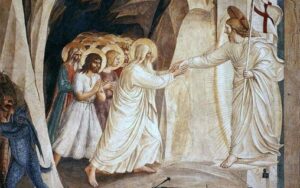
Fra Angelico’s Raising of Hell a.k.a. The Harrowing of Hell, or Christ in Limbo, is one of the frescoes painted by Fra Angelico (and his assistants) between 1437-1446 for the monastery of San Marco in Florence, located in one of the monks’ cells.
(Painting is in the public domain)
Dear friends,
With Easter so near the beginning of April, it seems timely to reflect on the last few days of Holy Week. The events of Maundy Thursday, the Last Supper and the agonised prayer in Gethsemane move inexorably into Good Friday. There is no time for Jesus to rest or steel himself for what is to come. The betrayal of Judas is followed by an armed arrest and the desertion of his friends. As the shameful, unjust trial takes place, Peter denies him – just as Jesus prophesied. Christ’s appearance before Pilate, the jeers of an angry, stirred-up mob lead to Golgotha and his crucifixion.
All this we have read or heard so many times over the years. Although the very familiarity of the Passion narrative may lessen the impact of its words, our reflection over those days, the readings and the hauntingly sad hymns keep our hearts focused on the sacrifice Jesus made for the sake of humanity – for all our sakes. We are sombre but, always, in the back of or minds we know this is not where the story ends and any sadness we feel soon gives way to the hope and joy of Resurrection.
It isn’t part of our usual tradition to think much about the Saturday that falls between Good Friday and Easter Sunday. More often it’s an overlooked day. We carry on with our domestic preparations for Easter Day itself, grateful perhaps for the few extra hours it lends us.
In the Catholic tradition though this is Holy Saturday. It is a day of silence, of prayer, and of waiting, thinking of Jesus in the tomb. It is a day for identifying oneself with the grief and loss of the disciples. It is a bridging time.
Some also hold the belief that this time between his death and resurrection was a time when Jesus went down into hell to free the souls of the faithful dead. Whilst there are no specific Bible verses that say Jesus descended into hell, it is hinted at in 1 Peter 3: 19 (preaching to imprisoned spirits), Acts 2: 27 (not abandoning his soul to Hades) and Ephesians 4:9 which argues that if Jesus ascended he must first have descended. And it is there in the Apostles Creed which declares that Jesus ‘descended into hell; on the third day he rose again from the dead; he ascended into heaven.’
This ‘harrowing of hell,’ as it is often described, has captured the imaginations of many artists over the years including Fra Angelico (see the picture above). ‘Harrowing’ used here portrays the concept of something being broken up and we see a triumphant Jesus breaking apart the defences of hell in an act of victorious liberation.
I wonder what you think about this tradition and if knowing of it now causes you to think differently, even in a small way, about that in-between day of Saturday?
Whatever your thoughts, I hope that you may feel led to spend some of that day in quiet prayer, to resist the busyness that might otherwise occupy your time and so prepare yourself spiritually for Easter that its joy may be undiluted.
He is risen! Hallelujah!
With every blessing,
Sharon
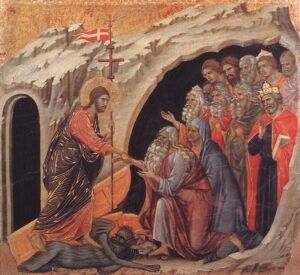
Descent to Hell,
painted by Duccio di Buoninsegna in 1308-11
(in public domain)